
DyFinance
Naviguez le monde de la blockchain et des cryptomonnaies en toute simplicité
À propos de DyFinance
DyFinance est une société basée à Genève (Suisse), facilitateur technologique spécialisé dans l'analyse des marchés crypto et la finance décentralisée.
La société propose deux types de services :
Conseils & formations
Dédiés aux utilisateurs novices et confirmés qui souhaitent acquérir de nouvelles connaissances ou perfectionner leurs compétences. Ce service est basé sur un accompagnement personnalisé en fonction des besoins et objectifs individuels.
Apporteur de liquidité "Pool"
En qualité de prestataire technique, DyFinance propose également une stratégie d'apporteur de liquidité, déployable en finance décentralisée (DeFi). Cette stratégie s'articule autour de protocoles audités et éprouvés, et permet de capitaliser à la fois sur les frais générés et sur l'appréciation potentielle des jetons. Elle s'adresse particulièrement aux utilisateurs recherchant une exposition passive, mais plus performante que la simple détention ou spéculation sur des jetons crypto.
La Blockchain et les cryptomonnaies en bref
La valeur du travail et de l'investissement a beaucoup évolué au fil du temps. De nos jours, le travail ne rémunère plus autant que par le passé, et ce pour une grande partie des travailleurs. L'investissement ou le placement est donc de plus en plus privilégié, afin de compenser a minima la perte de pouvoir d'achat et, au mieux, de développer sensiblement son patrimoine.
Les actifs numériques, de par leur nature, ouvrent de nouvelles opportunités accessibles à toutes les tailles de portefeuille, qu'elles soient conséquentes ou modestes.
Ces dernières années, l'émergence de la blockchain et des crypto-actifs en général a suscité beaucoup d'intérêt de par son aspect technologique novateur et également par les opportunités qui en découlent. La Finance Décentralisée (ou DeFi), est un écosystème et terme générique désignant des services financiers en pair-à-pair mis en oeuvre sur des blockchains publiques et sécurisées. La blockchain, ou encore ledger, est un "carnet digital" qui retrace et conserve l'historique de toutes les transactions effectuées sur cette infrastructure.
La DeFi se passe de nombreux intermédiaires et du contrôle centralisé grâce à la création de contrats auto-exécutables (smart contracts) dont les termes sont inscrits directement dans le code. Les cas d'usage sont nombreux, incluant notamment le prêt, l'emprunt ou l'échange d'actifs numériques. Cet écosystème émergent offre de nombreuses opportunités d'investissement qui découlent notamment de sa difficulté d'accès, et de sa complexité générale ainsi que de son évolution rapide.
La cryptomonnaie est une forme de monnaie numérique ou virtuelle qui utilise la cryptographie pour sécuriser les transactions et contrôler la création de nouvelles unités. Elle fonctionne sur un réseau décentralisé, généralement une blockchain. Les cryptomonnaies sont également utilisées comme moyen d'échange ou intermédiaire dans la finance décentralisée (DeFi).
La stratégie DyFinance
La stratégie DyFinance se concentre principalement sur la fourniture de liquidité au sein de pool de plateforme d'échange décentralisée. La stratégie consiste à déposer une paire de jetons crypto (exemple DAI et ETH). Une fois alimentée de jetons, cette pool de liquidité permet aux traders et utilisateurs d'acheter et vendre les jetons qui composent cette pool selon leurs préférences et les mouvements de marché observés et anticipés.
Les pools de liquidité utilisent des contrats intelligents pour permettre des échanges on-chain sans permission. En apportant de la liquidité, les fournisseurs de liquidité (ou LPs) contribuent à garantir que les traders et utilisateurs puissent échanger des jetons quelles que soient les variations de prix. En retour, les LPs capturent une part des frais de transaction. Plus la quantité de liquidité (donc la taille de la pool) est élevée, plus le fonctionnement de la pool est optimal. Un niveau faible de liquidité peut entraîner divers risques comme le slippage, différence entre la quantité de jetons espérée et la quantité actuelle reçue lors d'une transaction.
Dans cet environnement, les traders et utilisateurs n'utiliseront pas ladite pool et donc les frais de transactions sont faibles voire nuls.
La stratégie DyFinance se concentre sur deux objectifs principaux :
- l'accumulation des frais de transaction
- l'optimisation des seuils d'achat et de vente
Ces deux paramètres constituent le yield ou encore la performance globale. La stratégie est conçue pour surperformer la stratégie basique qui consiste à acheter puis à attendre passivement que la valeur du jeton augmente ("buy and hold" en anglais) sur un horizon de temps de moyen à long terme.
Nos Pools
DyFinance, en qualité de prestataire technique, élabore des stratégies de pool de liquidités suivant le modèle ci-dessous :
Pool Conservatrice
Ce type de pool est adapté pour les utilisateurs qui souhaitent faire leurs premiers pas, première initiation au système de pool de liquidités.
Pool Équilibrée
La pool équilibrée s'adresse à un public plus large, ayant plus d'expérience ou étant plus à l'aise avec la crypto. La performance devient un critère plus important.
Pool Dynamique
La pool dynamique est réservée aux utilisateurs ayant une expérience confirmée en crypto ou souhaitant prioriser la performance avant tout.
Vaults non-custodiaux et transparents
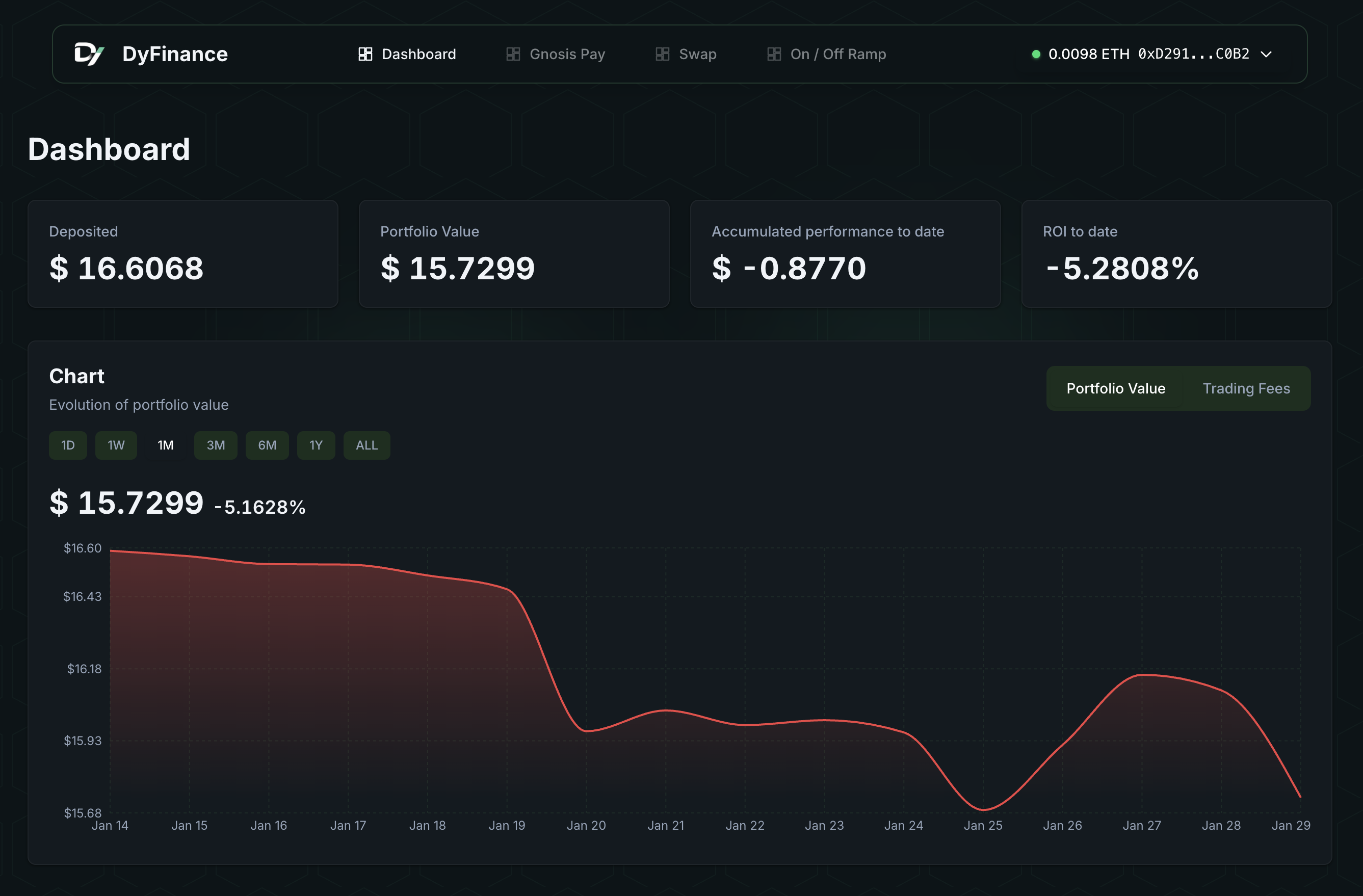
Optimisez l'accumulation de capital avec des stratégies automatisées. Suivez les frais, l'IL et le P&L en temps réel.
Transparent
Suivi en temps réel des frais, de l'impermanent loss et du P&L. Transparence totale on-chain.
Performant
Stratégie optimale pour les détenteurs long terme. Rééquilibrage automatisé sans gestion active.
Sécurisé
Vaults non-custodiaux. Vous conservez la pleine propriété de vos actifs.
Simple
Accès et navigation fluides. Déposez des USDC et laissez l'automatisation faire le reste.
Nos Outils
Tout ce dont vous avez besoin pour investir, simuler et suivre vos actifs crypto.
Acheter de la Crypto
Achetez des cryptomonnaies directement avec des CHF, EUR ou d'autres devises fiat. Notre widget intégré propulsé par Mt Pelerin vous permet d'acheter, vendre et échanger des tokens en toute simplicité.
- Achetez des USDC pour déposer dans les vaults DyFinance
- Échangez directement entre tokens
- Revendez vos crypto en monnaie fiat si nécessaire
Simulateur d'investissement
Valeur estimée à maturité*
—
*Par simplicité, le calculateur ne prend pas en compte l'impermanent loss.
Simulateur d'investissement
Estimez la croissance potentielle de votre investissement au fil du temps. Configurez le montant de votre dépôt, l'APR attendu et la durée d'investissement pour visualiser les rendements projetés.
- Calcul d'intérêts composés mensuels
- Durée ajustable jusqu'à 10 ans
- Hypothèses d'APR personnalisables
Traçabilité des fonds volés
Suivez et surveillez les fonds crypto volés grâce à notre outil avancé d'analyse blockchain. Tracez les mouvements on-chain, identifiez les portefeuilles suspects et contribuez à la récupération des actifs compromis.
Bientôt disponible
Cette fonctionnalité est en cours de développement.
Contactez nous
Pour plus d'informations, vous pouvez contacter l'équipe via le formulaire ci-dessous ou réserver un créneau.
Questions fréquentes
La fourniture de liquidité (ou liquidity provisioning en anglais) consiste à déposer une paire de tokens dans un pool de liquidité sur un exchange décentralisé. Les pools de liquidité utilisent des smart contracts pour permettre des échanges on-chain sans intermédiaire. Les fournisseurs de liquidité (liquidity providers en anglais) perçoivent des frais de trading en mettant leur liquidité à disposition des traders et utilisateurs de la pool.
La fourniture de liquidité comporte de multiples risques. Les principaux risques sont : le risque de marché ou volatilité, le risque lié au piratage des smart contracts, le risque de perte impermanente et enfin le risque opérationnel.
La perte impermanente (ou impermanent loss en anglais) représente la perte temporaire que subissent les fournisseurs de liquidité lorsque la valeur des actifs déposés fluctue à la baisse par rapport à la valeur des actifs détenus simplement. La perte impermanente ne se matérialise que lorsque la liquidité est retirée du pool.
Les utilisateurs potentiels peuvent demander des informations complémentaires en soumettant le formulaire ci-dessous. L'équipe les contactera ensuite via leur canal de communication préféré.